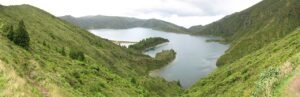
Lagoa do Fogo, the “lake of fire”, fills the crater of the Água de Pau volcano in the middle of São Miguel. Unlike Sete Cidades, there is no village and no road down to it: just a wide blue lake with pale sandy shores, ringed by steep green slopes, in a protected nature reserve. This guide covers the best viewpoints, the walk down to the shore, the warm pools of Caldeira Velha and the hidden lake of Congro nearby, and how to time your visit around the clouds.
- Where
- Centre of São Miguel, 35 minutes from Ponta Delgada
- What
- A crater lake in a nature reserve
- Time needed
- 1 hour for the views; half a day with a walk
- Best time
- Early morning on a clear day
- Entry
- Free; roadside parking at the viewpoints
- Facilities
- None at the lake: bring water and layers
At a glance
Highlights around Lagoa do Fogo
Tap any photo to see the place on the interactive map, with directions from where you are.
Miradouros
The best Lagoa do Fogo viewpoints
The road across the mountain between Lagoa and Ribeira Grande climbs right past the crater rim, with pull-outs along the way.
- Lagoa do Fogo Viewpoint: the main viewpoint on the south side of the crater, with the classic view over the whole lake. It is also where the path down to the shore starts.
- Barrosa Viewpoint: higher up on the rim, near the antennas of Pico da Barrosa, with a wider view over the lake and both coasts on a clear day. Windy and often cold.
- Roadside pull-outs: the stretch of road along the rim has several small parking spots; stop wherever the view opens up, but never on the bends.
On foot
Walking down to the lake
A steep, narrow path drops from the main viewpoint to the lake shore, where you can walk on the sandy beaches along the water. Allow about 30 minutes down and 45 minutes back up, longer if the path is muddy.
- Wear proper shoes: the path is steep, rocky and slippery after rain.
- It is a nature reserve: stay on the path, take your rubbish with you and don’t disturb the plants or birds.
- No shade or water at the lake: bring your own.
For a longer hike, a marked trail climbs to the lake from the south coast near Água d’Alto: a steady climb of a few hours through farmland and forest.
North side
Caldeira Velha: warm pools in a fern forest
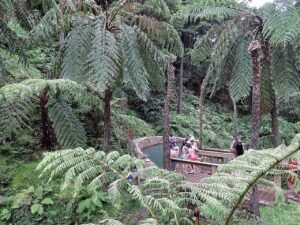
Ten to fifteen minutes down the north side of the mountain, Caldeira Velha is a small nature park where hot springs feed pools among giant tree ferns. The upper pool sits under a waterfall and is the coolest; the lower pools are much warmer. Visitor numbers are limited, so book a slot online in summer. Compare it with the other pools in our Azores hot springs guide.
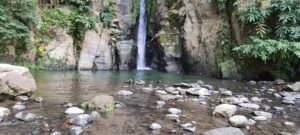
Close by, the Salto do Cabrito waterfall drops into a gorge near an old hydroelectric plant, reached by a short walk and a walkway.
Hidden lake
Lagoa do Congro
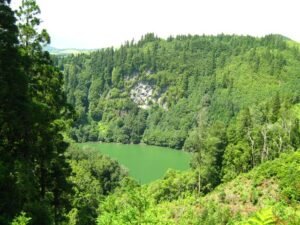
East of Lagoa do Fogo, Lagoa do Congro lies hidden at the bottom of a small, forested crater. From the parking area, a path leads down through cedars and ferns to the green water in about 10–15 minutes. It is quiet, shaded and beautiful in the morning mist: a good alternative when the big lake is in cloud.
Access
How to get to Lagoa do Fogo
- By car: about 35 minutes from Ponta Delgada. Take the coast road east to Lagoa, then the mountain road north towards Ribeira Grande, which passes the viewpoints. Parking is at roadside pull-outs and fills up on summer afternoons.
- Access rules: because of the crowds, local authorities have at times limited private cars on the lake road in peak season. Check the current situation before you go.
- Without a car: tours from Ponta Delgada often combine Lagoa do Fogo with Caldeira Velha and the tea plantations; there is no bus to the viewpoints.
Base yourself in Ponta Delgada or on the north coast around Ribeira Grande.
Clouds
When to visit Lagoa do Fogo
At nearly 600 m above the sea, the crater is often wrapped in cloud, even when the coast is sunny. Go early in the morning, check a live webcam before you drive up, and if it is foggy, visit Caldeira Velha or Lagoa do Congro first and try the viewpoint again later. See the Azores weather guide for more on the island’s microclimates.
Planning
A half day at Lagoa do Fogo
- Early morning: the Lagoa do Fogo Viewpoint, then the walk down to the shore and back.
- Late morning: continue over the mountain to Caldeira Velha for a warm bath (booked ahead).
- Afternoon: lunch in Ribeira Grande, then the tea plantations of Gorreana and Porto Formoso on the north coast.
Prefer the south? Combine the lake with Lagoa do Congro and the beaches of Vila Franca do Campo.
Questions
Lagoa do Fogo FAQ
Can you walk down to Lagoa do Fogo?
Yes. A steep path from the main viewpoint reaches the lake shore in about 30 minutes; allow 45 minutes or more for the climb back.
Is Lagoa do Fogo worth visiting?
Yes, it is one of the wildest and most beautiful lakes in the Azores, with no buildings in sight. Go on a clear morning for the best view.
How do you get to Lagoa do Fogo?
By car, about 35 minutes from Ponta Delgada on the mountain road between Lagoa and Ribeira Grande, or on a tour. There is no bus to the viewpoints.
Is Lagoa do Fogo or Sete Cidades better?
See both if you can. Sete Cidades is the famous twin lake with a village; Lagoa do Fogo is wilder and more remote.
What is near Lagoa do Fogo?
The warm pools of Caldeira Velha, the Salto do Cabrito waterfall, the hidden Lagoa do Congro and, on the north coast, Ribeira Grande and the tea plantations.
Why is it called the “lake of fire”?
It fills the crater of the Água de Pau volcano, whose last eruption, in the 16th century, gave the lake its name.